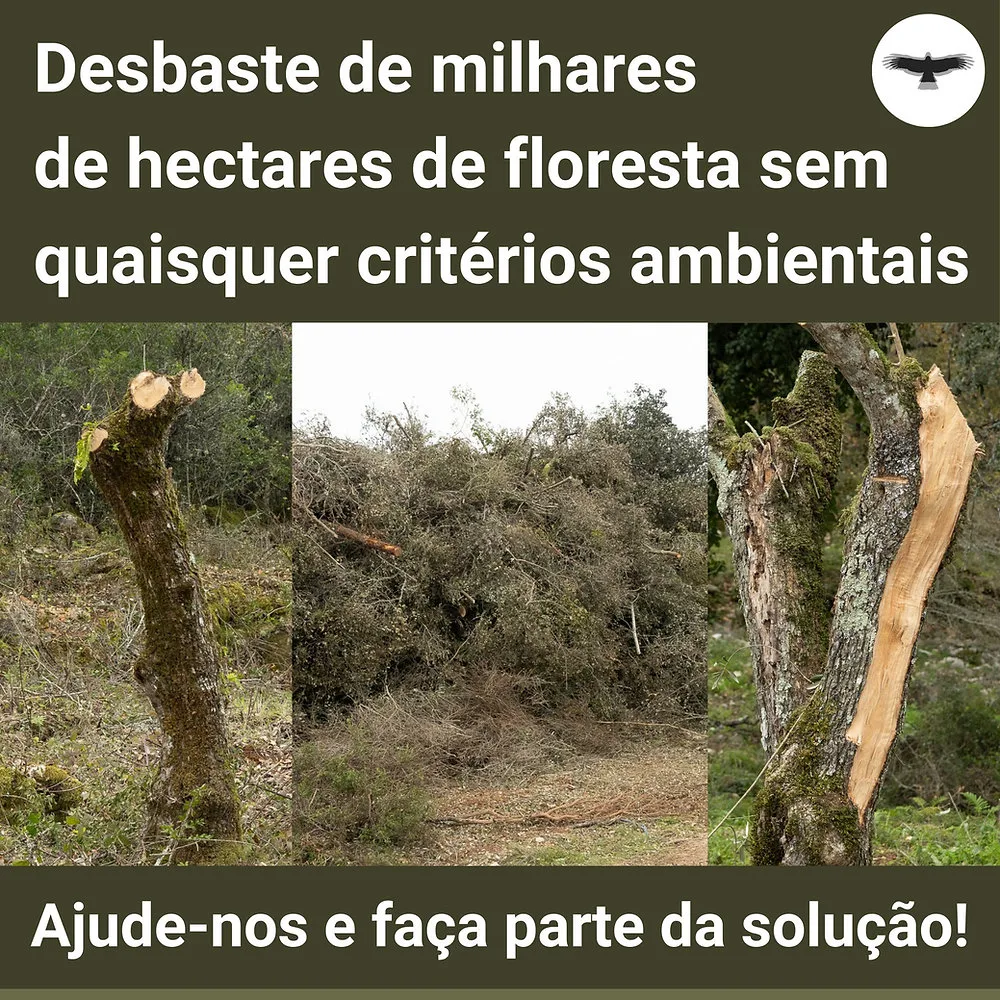
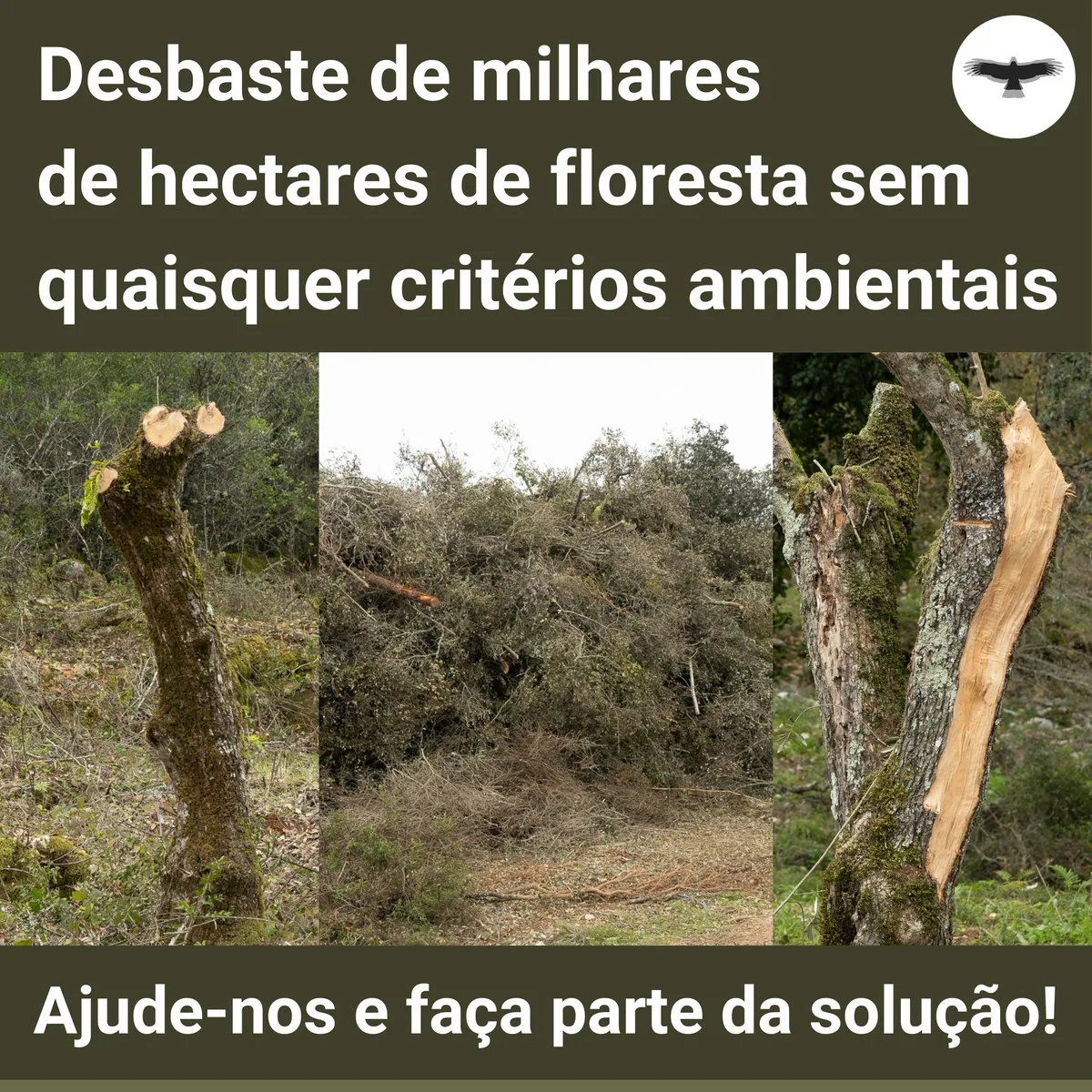
 Portuguese forests are suffering indiscriminate thinning as a result of the implementation of the National Forest Fire Defence Plan. Among the glaring examples of the broader problems with this plan is the recent felling of hundreds of holm oaks along several kilometres of road between Pelmá and Loureira, in the municipality of Alvaiázere. This specific case reflects a worrying trend extending from north to south, where territories rich in biodiversity — protected at national and European level — face massive and indiscriminate interventions.
The Municipality of Alvaiázere is promoting the indiscriminate felling of holm oaks, cork oaks, olive trees, and other species, in an area fully classified under the Natura 2000 Network — constituting a true environmental assault that jeopardises not only biodiversity but also cultural and tourism values. Milvoz, aware of this critical situation, reported the incident to the Nature and Environment Protection Service of the National Republican Guard (SEPNA) and the Institute for Nature Conservation and Forests (ICNF), highlighting the lack of environmental criteria and the dangerous precedent this action sets.
Detailed analysis of the Alvaiázere Municipal Forest Fire Defence Plan by Milvoz reveals an intervention projected to cover 1,500 hectares per year until 2030, at an estimated cost of 15 million euros. The plan, which was supposed to address fire protection and forest conservation, appears to be limited to the indiscriminate felling of trees, without considering ecological criteria or its interconnection with other strategic plans in force. The land use and vegetation structure characterisation in the municipality are merely cosmetic appendices to the document, following purely physical and economic parameters. There is no attempt whatsoever to integrate indicators relating to the ecological integrity of the site, the presence of protected species and/or priority habitats. It is troubling to realise that this is but a small isolated example in just one municipality, within the 278 municipalities of mainland Portugal, where similar assaults are undoubtedly being replicated, affecting thousands of hectares annually until 2030!
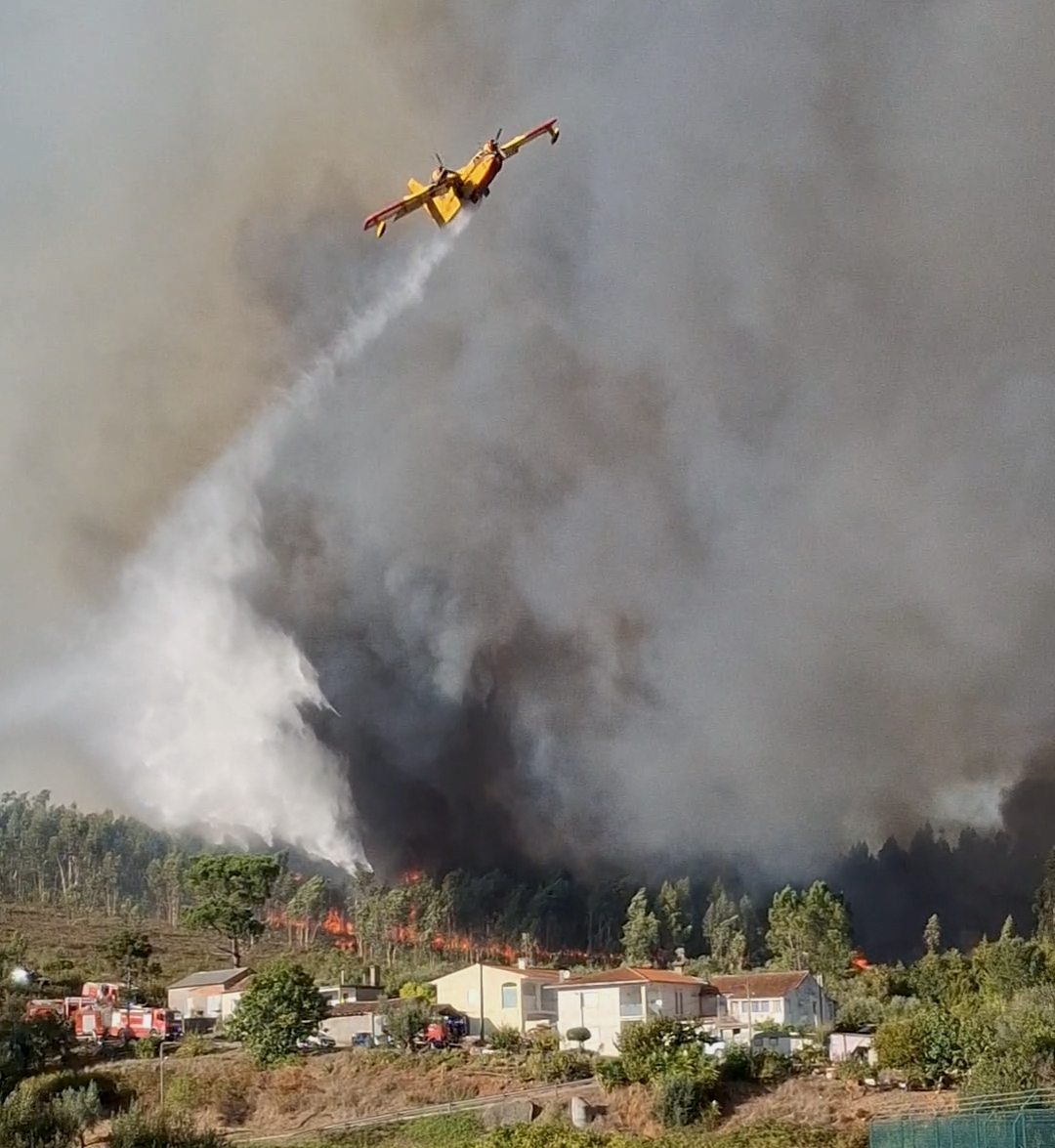
The situation becomes even more alarming in light of Decree-Law No. 82/2021, which prioritises fuel management — including in classified areas with protected trees — effectively authorising the felling of any type of tree in any zone. This results in negligent and damaging interventions throughout the country, as evidenced by this example, where protected habitats and significant biological values were disregarded. The urgent need to revise the fuel management rules is evident, as with every passing month and year the country loses hundreds of thousands of hectares of native forest in good conservation status. In a context where vast areas of the national territory already face degradation due to invasive species, abandoned intensive eucalyptus plantations, and rapid soil erosion, among other problems, the destruction of priority conservation zones is absolutely unacceptable, representing an irreparable loss for biological diversity and a complete disregard for the environmental targets and commitments assumed at national and international level.
Even without denying the potential need for fuel management strips, it is crucial that such strips circumvent the protected woodland and ideally allow for its expansion, rather than gutting what one seeks to protect. In the (poor) national forest landscape, it is hard to imagine regions where there are no ecologically less valuable alternatives that would not significantly increase the associated costs — and it should be preferable to apply the strips to those areas instead. In the most degraded parts of the country — particularly in areas with extensive post-fire vegetation, disorganised timber plantations, and land infested with invasive species — fuel management should be combined with the planting of native species capable of forming shaded areas where the growth of fine fuels is hampered. These species would not only act as natural firebreaks but would also function as ecological corridors, connecting different regions and promoting biodiversity.
The current fire protection model does not effectively account for the varying population densities and built-up areas of different parts of the country, nor for the differing values of each region. The blanket application of the national plan across different regions will result in significant inconsistencies, ineffective actions, and unsustainable long-term financial expenditure. It is imperative that fuel management and fire prevention policies are revised so as to genuinely integrate the natural values of specific areas, prioritising ecosystem preservation and the promotion of sustainable practices. In the long term, it is essential to strike a balance between fire safety and environmental preservation, guaranteeing a sustainable future for our natural heritage.
Rural regions of the country — especially those that still maintain well-preserved natural areas — are strategic assets for diversifying the national tourism offering, adapting to climate change, and providing essential ecosystem services. Plans such as this contradict investments in those very same areas, highlighting the lack of integration between local policies and plans.
This is a call to society to unite in the fight against this calamity, which not only destroys our natural heritage but also imposes disproportionate public financial costs. Fuel management cannot come at the cost of the irreparable destruction of our essential natural resources. Milvoz will not stand for it! We therefore invite all interested citizens and entities to join us in a working group aimed at resolving the problem. Everyone is welcome — from civil society to the public and private sectors, as well as any concerned citizen. We will form a strong and diverse group to get to work!
We ask all those interested in helping to please send an email to geral@milvoz.pt with a brief introduction about yourselves (individuals or organisations) and a short explanation of your interest in collaborating towards a solution.
Join Milvoz in the fight for a paradigm shift in fuel management and the protection of our natural heritage!